-
 The Tennis Complex at FGCU and The Courts at Cape Coral were both awarded 2026 Outstanding Facility Awards by the USTA.
 -
 During September, two exhibitions open, six close and 23 others continue their runs.
 -
 The Wasmer Art Gallery at Florida Gulf Coast University is currently exhibiting “The History of the United States, Vol. I & II, 1774 – 1844.” There is one print for each year, each created by different contemporary artists. Some chose well-known events while others more obscure conceptual ideas, all of which were tied into what was happening during those years. During the opening reception, WGCU's Mike Kiniry was joined by three FGCU professors who had been asked to look over the collection and choose a few prints that they wanted to reflect on from their own area of expertise. The panel was comprised of Dr. Rick Coughlin, Professor of Political Science & Government; Dr. Jordan Von Cannon, Associate Professor of American Literature; and by Dr. Sarah Rodriguez, Assistant Professor of History. They were also joined on the panel by Knox Naumes-Hoch — he's a former FGCU dual-enrolled student who is now studying at College of the Atlantic in Bar Harbor, Maine. Knox wrote the labels for every print to provide some historical context.
 -
 Venice Beach is often referred to as the shark teeth capital of the world, but there had never been formal, peer reviewed documentation until a Florida Gulf Coast University professor published a paper breaking down what he and his students found beneath the waters there. The Venice shark and ray assemblage contains 45 species identified from their fossil teeth, all collected by Dr. Harry Maisch, Assistant Professor of Earth Science in the Department of Marine & Earth Sciences in The Water School at FGCU. We learn about his research, and this area's fascinating geologic past.
 -
 A woman dedicated to helping FGCU students get internships all around Southwest Florida has won the award as Young Professional of the Year, given by the Greater Fort Myers Chamber of Commerce.
 -
 Up until the early 1900s about three-quarters of Florida’s southern coast, from about Tampa Bay on the Gulf side around to The Indian River Lagoon on the Atlantic Ocean, was covered with, and protected by mangroves. After coastal development took off in the 1900s hundreds of thousands of acres of mangroves were removed in urbanizing coastal regions. Mangroves are important for many reasons, so we have a Mangroves 101 conversation to learn about the role they play in our coastal ecosystems. Our guests are Dr. Brian Bovard, Wetland Plant Ecologist in the Department of Ecology and Environmental Studies within the Water School at FGCU and Dr. Win Everham, Professor in the Department of Ecology & Environmental Studies at FGCU.
 -
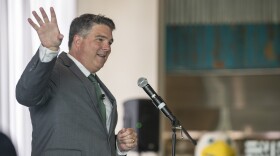 Florida Gulf Coast University’s new Director of Athletics Brian Barrio, at his first official press conference Monday, said he’s off to a good start and fired up about what can be accomplished here.
 -
 Hosted by FGCU professor Dr. Joel Ying, this year's storytelling conference explores storytelling as healing through curiosity and compassion.
 -
 During the month of June, three exhibitions close and 30 others continue their runs at museums from Marco Island to Sarasota.
 -
 Rachel McIntyre has spent more than two decades developing and operating Open Doors.

© 2026 WGCU News
PBS and NPR for Southwest Florida
Play Live Radio
Next Up:
0:00
0:00
Available On Air Stations


