
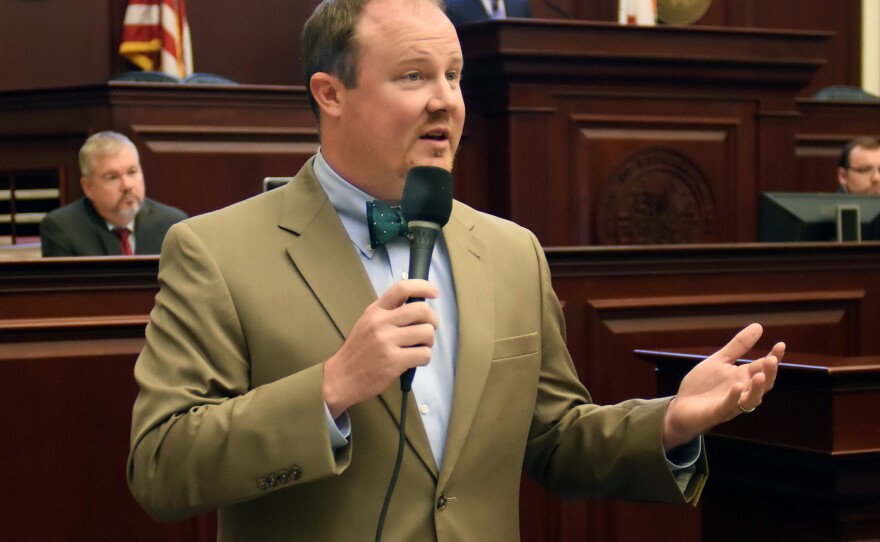

Members of Southwest Florida’s state legislative delegation met with business leaders and local elected officials at a Chamber of Southwest Florida luncheon in Fort Myers Tuesday to discuss the successes and failures of this year’s legislative session, which ended May 8.
Eight state lawmakers from Southwest Florida attended the Chamber event at The Club at Pelican Preserve. Members of the all-Republican delegation uniformly celebrated the passage of SB 10 to create a reservoir South of Lake Okeechobee in an effort to move more water south through the Everglades and to alleviate harmful discharges of nutrient-laden water into the Caloosahatchee and St. Lucie Rivers. Sen. Lizbeth Benacquisto, R-Fort Myers, was instrumental in brokering that deal which includes constructing the reservoir on land the state already owns as well as an economic development plan for communities in Glades County.
“The passage of Senate Bill 10 and the creation of that southern storage, the reservoir, and an allocation of $106 million to work on the C-43 reservoir was also huge for Southwest Florida,” said Benacquisto.
Rep. Heather Fitzenhagen, R-Fort Myers, said the passage of the Okeechobee Reservoir bill was an emotional moment for her.
“I literally had tears of joy when we passed that because I was so happy,” said Fitzenhagen. “So that’s a great victory for all of Southwest Florida and all of Florida because the Everglades will get more water and our estuaries will be safer.”
A bill to implement the voter-approved amendment to expand medical marijuana failed to pass in the final days of the session. Local lawmakers pointed to that failed negotiation as one of their greatest disappointments. Rep. Matt Caldwell, R-Lehigh Acres, said, even though implementation of the amendment can go forward without the legislature, he supports House Speaker Richard Corcoran’s call for a special session to address the medical marijuana expansion.
“Pretty much everyone in leadership in the House thinks we should come back for a special session. I am among them and leader Rodrigues,(Ray Rodrigues, R-Fort Myers) who carried the bill, is ready to come back,” said Caldwell. “So, were just looking for either the governor or the Senate President to agree and we’ll be there.”
However, Sen. Kathleen Passidomo, R-Naples, said a special session on medical marijuana may not be needed.
“I don’t believe it’s a death knell for the process if we don’t because we already have a framework in place that we created in 2014 when we passed the legislation authorizing Charlotte’s Web,” said Passidomo. “So, the Department of Health can continue with that. Right now, there are only 5,000 people on the registry. So, as the numbers grow, then the legislature could weigh in, but I don’t think that it’s absolutely necessary that we spend $50 to 60 thousand dollars a day in a special session when we’re coming back in August.”
The budget passed by the state legislature could, itself, prompt a special session this summer. Gov. Rick Scott had campaigned heavily in recent months in favor of funding for Florida’s business incentive grants awarded through the public-private partnership, Enterprise Florida and for the state’s tourism marketing arm Visit Florida. However, lawmakers eliminated state funding for Enterprise Florida, and cut Visit Florida’s budget from $76 million to $25 million. That may prompt Gov. Scott to veto the entire budget, forcing lawmakers back to Tallahassee. Even so, Sen. Benacquisto said the legislature largely stands by the budget.
“The Enterprise Florida structure needed to have additional accountability and transparency and make sure that its effectiveness is clearly tracked and investment is made only in those projects that are valuable,” said Benacquisto. “In terms of Visit Florida, we agree there, that that is a very worthwhile endeavor and while the funding level is lower, the integrity of the program is still intact so that we can do the work that needs to be done to attract visitors. We just have to do it more efficiently.”
Rep. Caldwell echoed that sentiment.
“Ultimately, I think, where Visit Florida ended up at $25 million guarantees it can meet its core function. The major players in tourism, the Disneys and the Universals of the world, they’ll be successful advertising for themselves,” said Caldwell. “I do think Visit Florida does have a role when you look at our beaches and our state parks. These are fantastic natural areas that could use advertising and draw folks in.”
Gov. Scott has not yet indicated what he plans to do regarding the budget. In the meantime, Sen. Passidomo is celebrating the passage of 13 bills she championed during her freshman term in the Senate. She says, most notably was the passage of SB 206 to legalize electronic wills.
“Personally, it was sort of an odd bill for electronic wills which is going to be groundbreaking,” said Passidomo. “The first state in the country to allow people to create, sign and store wills electronically.”
Going back to her time in the State House, Sen. Passidomo has sponsored failed efforts to address roadway safety for cyclists and pedestrians. That bill failed to gain traction again this year, but Passidomo says plans to bring it back next year.
Meanwhile, Rep. Fitzenhagen says a personal legislative effort she was most happy to see pass relates to the health of newborns.
“I passed a bill that will help newborn testing to be more thorough so that children can get the intercession they need right after birth to save them from a lifetime of pain and suffering,” said Fitzenhagen.
Fitzenhagen said her biggest personal legislative disappointment also concerned healthcare. It was her effort to establish a cancer preemption statute relating benefits for firefighters and their families when it comes to forms of cancer that can develop due to exposure in the line of duty.
Southwest Florida lawmakers were also uniformly disappointed in the legislature’s failure to pass a bill revamping the state’s workers compensation insurance laws. That measure came in response to a 14.5% rate increase for workers compensation benefits paid by businesses that went into effect late last year. That bill was defeated amid debate over limits on attorney fees paid in injured worker cases.
While most members of Southwest Florida’s legislative delegation are preparing to return to the state capital in August, Rep. Caldwell is hitting the campaign trail after officially announcing his candidacy this week to be Florida’s next Commissioner of Agriculture and Consumer Services.
“It’s 67 counties, millions of people we’ve got to go see. We’re going to be on the road definitely five-six days a week,” said Caldwell.
Last month, Governor Rick Scott signed a bill that will move up the start of next year’s legislative session from March to January.


