A Florida Fish & Wildlife official said Wednesday that the agency can't confirm a dead female eagle recovered Friday is that of the missing female raptor from a North Fort Myers nest.
FWC staff recovered the carcass of a bald eagle on Friday, February 27, in North Fort Myers between one and two miles from the Bayshore Road nest of F23 and M15.
The female eagle's apparent injuries were consistent with a vehicle collision.
FWC public information officer Bradley Johnson said that while FWC avian staff are aware that F23 has not been observed at its nest recently, the FWC cannot confirm that this individual was F23, as neither eagle observed using the nest was banded.
"Without a female present, it is still likely the male eagle can raise the chicks on its own or find a new mate," Johnson said in a text to WGCU.
Southwest Florida Eagle Cam officials have also posted that the eagle that was found dead did not die from foul play. The cam's website has kept an eye on the eagles at the nest along Bayshore Road for more than a dozen years.
"While there is no definitive way to confirm that the deceased eagle reported to local authorities was F23. The Florida Fish and Wildlife Conservation Commission (FWC) has confirmed that no evidence of foul play was observed. Based on their preliminary assessment, the eagle most likely died from blunt force trauma due to a vehicle strike," the cam operators posted on social media shortly after noon Wednesday.
Additionally, the cam operators said that because bald eagles are often drawn to roadways due to roadkill, and because of their size and slower lift-off speed, they can be especially vulnerable to vehicle strikes.
They warned that F23’s likely death is a stark reminder to remain observant while driving — particularly near water, wooded areas, and anywhere roadkill is visible. Slowing down and scanning road shoulders can make a difference.
"If you ever encounter an injured eagle, please do not approach it. Contact the appropriate wildlife authorities (@myfwc or @crowclinic ) so trained professionals can respond safely," the cam operators stressed. "If greater awareness can help protect even one eagle in the future, we honor the legacy that F23 leaves behind."
The FWC had a similar directive to area residents: "The FWC values the public's commitment to protecting our state's native wildlife. To ensure the health and well-being of Florida eagles, we encourage the reporting of any sightings of dead, injured, or sick eagles to our Wildlife Alert line at 888-404-FWCC (3922). Sightings of dead eagles can also be reported to the FWC’s Avian Mortality app: https://app.myfwc.com/FWRI/AvianMortality/. Bald eagles are protected by both the FWC and the USFWS. The state eagle rule (68A-16.002, F.A.C.), and two federal laws protecting eagles, the Migratory Bird Treaty Act (MBTA) and the Bald and Golden Eagle Protection Act (BGEPA or Eagle Act). For more information about the federal laws, please visit the USFWS bald eagle website: https://www.fws.gov/program/eagle-management"
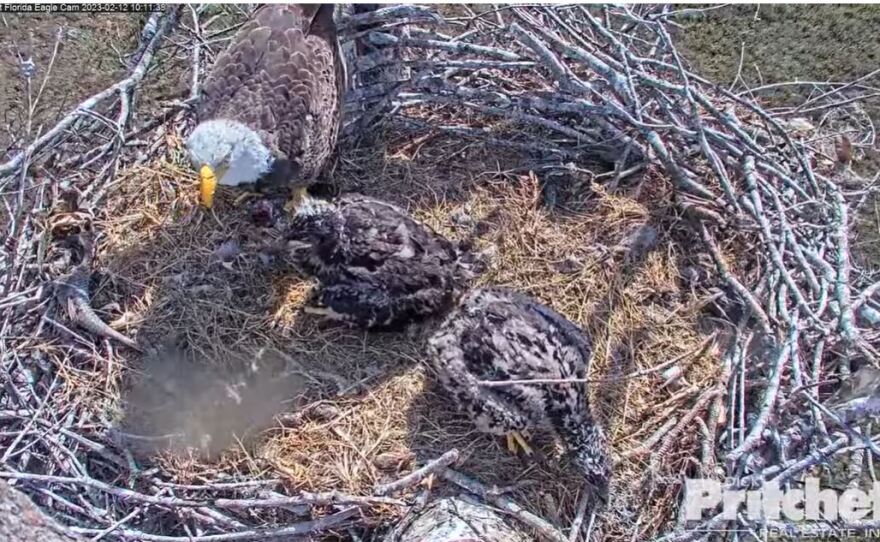
F23's disappearance is the second time in three years that an eagle mother has gone missing. The male of the bonded pair, M15, has been tending to E26, the surviving eaglet of two from this year's clutch.
The disappearance is similar to the last time. In early 2023, the previous female eagle on the same nest, Harriet, also went missing. She was never found.
But life went on that time as well with mate M15 taking on an expanded role and successfully helping the pair's two eaglets fledge the nest eventually.
This year's eaglet, E26, is also close to fledging the nest.
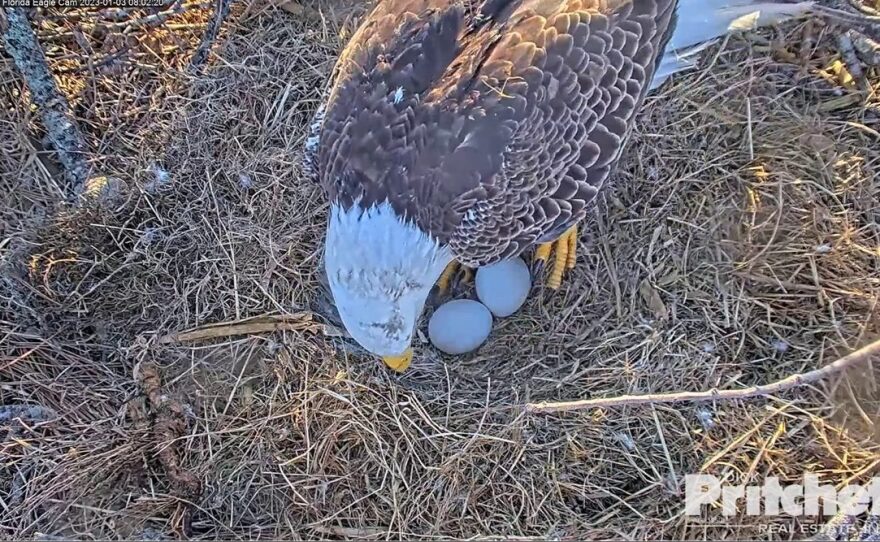
There have also been other tragedies with the nest. This season, one of two eggs failed to hatch and last year both eaglets hatched but died weeks later, likely from the avian flu.






WGCU is your trusted source for news and information in Southwest Florida. We are a nonprofit public service, and your support is more critical than ever. Keep public media strong and donate now. Thank you.