


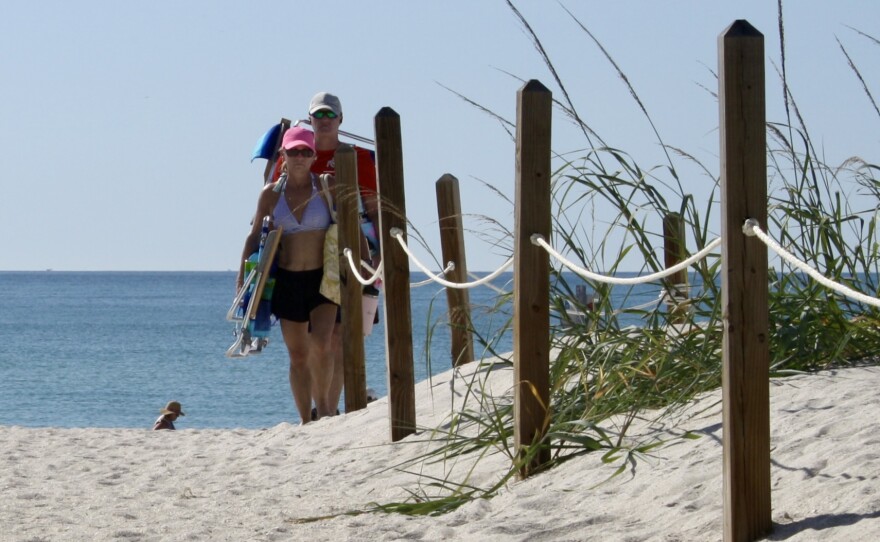


Some people who stroll Southwest Florida’s beaches may expect crystal-white sand peppered with seashells and shark teeth, graced by a smooth landscape sloping down to the shoreline.
Odd Nygirt is a part-time resident of Southwest Florida from Norway, arriving every November to escape the cold. He said during the 10 years he has lived at the Shell Island Beach Club on Sanibel Island, his favorite spots remain the beaches.
Nygirt said he prefers beaches sprawling with vegetation and dunes rather than bland landscapes lacking character. But following Hurricane Ian’s arrival in Southwest Florida, destroying much of the coastal characteristics Nygirt values, he said the beaches became much broader, lacking both vegetation and varying elevation.
Nearly three years later, he said, he has seen a resurgence of these physical features. It worries him, though, when he sees people disturb this progress.
“It’s not OK at all. They should be more aware of what they are disturbing, what they are doing.”Odd Nygirt
The permeating plight
Vegetation on beach dunes may look like sand-covered weeds, but there’s more to these mounds than meets the eye. Jeannine Richards, Ph.D. and assistant professor of ecology and environmental studies at Florida Gulf Coast University, said that when people interfere with these delicate habitats, the repercussions are far greater than just leaving a footprint.
“I think we lose a lot of protection along our coastline,” Richards said. “Some of our beaches, we have this aesthetic of we want this just bare white sand without plants on it. And I think that’s a mistake. I think we’re sacrificing some of our protection.”

Richards said this loss of protection is a reason why it’s illegal on some Southwest Florida’s beaches to walk on, disturb, drive on, or trample on dune systems and vegetation. It harms plant growth and reduces protection from storm surge — an integral attribute beach dune systems provide to low-lying islands and coastal communities, according to Richards.
The disconnect
But she said there’s a problem — some beachgoers are unaware of this fact and the motives behind it. They will unknowingly roll their coolers over, drag an umbrella through, or step directly on plants — actions that, according to Richards, damage dune health and reduce levels of protection onshore. She said it happens almost every day as people visit Southwest Florida’s beaches.
“The plant on the dunes is really the key part. We’ve seen what happens when we don’t have them. A lot of them were pretty much eliminated during Hurricane Ian, and we put in emergency berms, but we didn’t plant plants on top of the sand we added, and that sand blew away, washed away, and those berms were gone.”Jeannine Richards, Ph.D.
Richards said when coastal vegetation grows on beach dunes, each plant plays an integral role in preserving a beach’s foundation. The diverse root structures of some plants can grow down over 6 feet. Plants like sea oats (Uniola paniculata) lock the dune’s foundation in place—while others like the dune sunflower (Helianthus debilis) tend to spread above ground and secure sand from wind or rain erosion.
While there is no state law explicitly prohibiting walking on beach dunes, Chapter 161 of the Florida Statutes lays the groundwork for local municipalities to create and enforce their own ordinances such as the Town of Fort Myers Beach’s Beach and Dune Management Ordinance.
It also includes a state law prohibiting the harvesting of sea oat and sea grape plants. These plants are one of the countless others that Richards said play an integral in maintaining a solid beach dune foundation.
The chapter does stipulate no driving on beach dunes and also describes the conditions and permits required for any coastal construction project that, “includes any work or activity which is likely to have a material physical effect on existing coastal conditions or natural shore and inlet processes.”
A cascading failure
Joel Caouette, an environmental biologist with the City of Sanibel Nature Resources Department, said healthy beach dunes also provide prime habitats for countless species, such as the gopher tortoise, a threatened species throughout Florida.
“Gopher tortoises make burrows in there (beach dune systems) and gopher tortoises are what’s known as a keystone species. They not only provide a home for themselves, but also up to 350 species…all the way down from the tiniest invertebrates to snakes and mammals.”Joel Caouette
Caouette also said the dunes provide protection for sea turtle hatchlings as they are sensitive to light and use moonlight to guide their path after hatching.
“Having a robust dune helps to buffer any man-made light from trespassing onto the beach, because having a dark beach is ideal for sea turtles,” Caouette said.
Both Richards and Caouette said it is easy to determine whether a dune is healthy and stable or not.
“You want to have a robust, biodiverse dune system with as many plant species as possible,” Caouette said.
Just go with the flow
Richards, Caouette, and Nygirt all said the same — the best way people can help is by heeding signage that prohibits entering into a dune system. Nygirt wants to take it a step further by adding context to the signs themselves beyond simple messages like, “keep off the dunes.”
“It should be more like some signs here to tell you what they are,” Nygirt said, ”what they are doing, what they are disturbing when they’re walking on the dunes — like that.”
All three also hope beachgoers can see how important these natural features are to not only stabilizing the immediate surroundings, but also the greater coastal ecosystem, its inhabitants, and the surrounding coastal communities that depend on this natural armor against Mother Nature’s growing wrath.
“A lot of people come down here for the natural beauty of the island and the area and things like that. And if we don’t preserve it, then there’s not going to be anything left.”Joel Caouette
To view specific ordinances, visit City of Sanibel, Fort Myers Beach, and other local coastal municipalities.
Support provided by the Franklin R. Edwards Memorial Fellowship. WGCU is your trusted source for news and information in Southwest Florida. We are a nonprofit public service, and your support is more critical than ever. Keep public media strong and donate now. Thank you.


