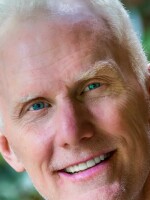
On a chilly morning this fall, Adam Welz wades through chest high grass in New York state's Adirondack Park, pausing often to scan with his binoculars and listen.
"That's a northern flicker, right?" he says. "That does the wok-wok-wok-wok!"
Welz, who lives in South Africa and spent years here in New York, describes himself as an old-school naturalist who likes to dive into places full of living things.
"Smelling them, hearing them, accessing them and then figuring out maybe how they fit into a greater ecosystem," he says, describing his approach to understanding the wild world.
We agreed to meet here and talk about his new book, The End of Eden: Wild Nature in the Age of Climate Breakdown, because Welz says places like this help him feel hopeful in a troubled time. New York's massive, 6-million acre Adirondack Park is one of the wildest places in the eastern United States.

The experience of wildness also helps him think more clearly, he says, about climate and the risks we take pumping more and more carbon into the atmosphere.
"Some very strange things are happening in certain places that nobody predicted," he says. "It's unnerving."
One of the big threats to this northern forest? Invasive insects are more easily able to spread in devastating waves because of milder, shorter winters.
"Insects that previously were confined to the more southern reaches of the U.S. are now moving into these colder areas of the Northeast, just with a tiny increase in winter minimum temperatures," Welz notes. "They're having massive effects on these woodlands."
In the book that grew out of his travels around the world, Welz lays out a portrait of climate change not as one big, abstract thing, but as a growing network of sometimes surprising, sometimes hard-to-see fractures or breakdowns in the natural world.

One chapter, for instance, describes the bird species vanishing from many deserts because it's simply too hot to forage for food or care for their young.
"We don't see thousand of birds falling out of the sky dramatically during a heat wave," Welz says. "What happens, though, is birds have to stop and do nothing, and sit in the shade and just pant."
Welz says he struggles with how to observe and describe what he calls the "weirding" of nature without feeling despair.
"Writing the book was extremely difficult at times," he says. He managed to finish the project by leaning into a naturalist's scientific curiosity. "I'm desperately curious to see how this works out, basically. My curiosity is what's pulled me through a lot of dark times."
Welz says his research convinced him many wild ecosystems around the world won't survive. That's the grim part of his narrative.
But he also believes despair over climate change is mostly unfounded. He describes it as a cop-out, in fact.

Welz notes there are many ways people and politicians can act to reduce the use of oil, coal and other fossil fuels, which remain the primary drivers of global warming.
There are also ways to repair many of the growing fractures in the world.
One example, he says, is New York's Adirondack Park, where we're walking. This region has grown a lot wilder over the last century.
Locals, environmentalists and government scientists created policies that protected huge areas of forest and wetlands. The goal was to protect wilderness areas and wildlife habitat from development. But along the way, Welz says, they made the Park far more resilient to climate change.
"This is a much more diverse, much more stable system than it was a hundred years ago because of these efforts to protect certain areas and allow species, wild species, to re-establish themselves," Welz says.
As we talk, a flock of tiny chickadees sweeps around us, so close we can feel the brush of wind from their wings. Welz grins in pleasure at the scene.
"This is not effort that's been wasted," he says. "There's an accumulation of good that comes from trying to put things back together again."
Welz says he hopes more people will connect to wild places like this, both because they're beautiful and hopeful, but also because we need to remember our dependence on the natural world for basic needs like food and water.

"Human society is completely reliant on the predictable functioning of ecosystems," Welz says. "We are pushing those ecosystems into unstable states, driving up uncertainty, pushing ourselves deeper and deeper into the unknown."
It will take lots of projects, big and small, all over the world, to help ecosystems begin to heal, Welz says. But that effort could also ease the impact of climate-fueled events like the more intense fires, droughts and heat waves that are already reshaping our human lives.
Copyright 2023 NPR. To see more, visit https://www.npr.org.